Tuesday, 23 April 2013

Props to me

Left in charge of props/production design I set about accumulating everything we would need from the tent and camping gear to the appearance of the 'creep' character.

As a fairly generic slasher/horror our film features a killer, and every killer needs a signature weapon. I set about creating ours using a baseball bat that I'd previously broken whilst recording some sound effects for a different project, sanding down the paint and coffee-staining it to give it an aged appearence.


I then hammered some nails into it and gave the tip some residual blood stains. Wanting to make the blood look aged I first smeared on some marmite and then added fake blood, which always gives away its artifice when it dries, looking overly pink, but discovered the marmite helps to keep it looking dark and fresh.


The end result is a formidable bludgeon that the unfortunate campers will get all too acquainted with.

We also needed a tarpaulin for the killer to drag a body in, I ended up using the ground mat from a 6-8 man tent and tying it up with rope...

... the corpse proved more difficult to acquire.

When the female character is found she has a burlap sack on her head. This came in the form of a scarecrow mask I had previously made for Halloween. We avoided having it in fully focused in frame to spare ourselves trouble with any bat-lawsuits.


Owing to sparse pre-production meetings we didn't get round to casting actors and as I had grown a beard to play the role of a homeless man in my drama film the role of 'creep' fell to me. 


I basically recycled this entire outfit, minus the hat and with the hood up, as it fell pretty close to what I had envisioned when I first read the script. Not pictured are some clunky black boots ideal for kicking bodies into ditches


I also experimented with liquid latex to create a burn scar prosthesis but didn't use it as we wanted to keep the  killers face obscured and so it would have been pointless time wasted on make up. 

Monday, 22 April 2013

Looooooong take


Perhaps the most famous sequence in Martin Scorsese's Goodfellas (1990) is the long steadicam take that follows Henry on a date through the bowels of the Copacabana club and out to a specially prepared table. According to the commentary at the start of the video Scorsese wanted fluidity and felt that cuts would serve as too much of a barrier between Henry and his newfound life of luxury. The sheer amount of co-ordination/choreography with extras is astounding and apparently it only took 8 takes, though in the final one used  you can observe Ray Liotta accidentally bump into a table corner.


This tracking shot provides an excellent feel for the club in Kill Bill: Vol. 1 (2003) as the crane dips in and out of the corridors of the set and scans around the dance floor.

Although I couldn't find any specific clips, Enter the Void (2009) features numerous long takes of crane shots that track across the rooftops as Oscar's disembodied soul floats across Tokyo's neon skyline. These do become somewhat repetitive after a time but are none the less impressive.


 Most Fight/action sequences rely on quick editing to deliver their blows. This is not the case with Warrior King/The Protector/Tom-Yung-Goong (2005), as it is called respectively in the UK, US and its native Thailand, which features perhaps the most incredible fight ever recorded for film. With almost four minutes of continuous steadicam action as Tony Jaa fights his way up a staircase, destroying numerous props and stuntmen along the way, this is easily the most ambitious martial arts sequence conceived for cinema and the crew took over a month to prepare and choreograph it. The DVD extras reveal that it only took 5 takes to nail, and that they were only available to film two takes a day because of the set repair and prop replacement.

http://videosift.com/video/Tony-Jaa-staircase-scene-Longest-unedited-fight-sequence
This post details each
They shot the first take which had a number of problems with stuntmen cues, and even a stuntman bumping into the stedicam operator. After choreographing more dynamic action, an increase of extras and improving the set, the next take they did was 17 days after the first take.

The second take was better but when the stuntman was supposed to be thrown from the 3rd story, the safety mattress was not completely in place yet so Tony Jaa stopped the shot and saved the stuntman's life.

The third take was just about perfect but just before Tony Jaa was supposed to bust through the last doorway, the film ran out. The director finally decided that instead of simply cutting there, they would try again for perfection.

They thought the fourth take was perfect but after review there were some parts that weren't as good as the pervious takes. They decided on one more try.

On the fifth try, it was almost perfect. But there were 2 miscues. On the 2nd floor, Tony Jaa slams a door into the head of a stuntman and the small glass window on the door was supposed to break. It failed to do so, so they used CGI to fix this. The 2nd issue was the fight just before the sink gets thrown. The timing was off as planned but the end result looked natural so they decided this was the take to use in the final film.

The crew also needed a foreign steadicam operator as the mount was built for American/European operators who are generally of a larger build than Asian operators. However the foreign operator they hired could only do two flights of stairs at a time and gave up so they ended up using a Thai operator who spent a month physically preparing for the job!


Another amazing continuous fight scene comes in the form of the corridor battle in Oldboy (2003), which recalls the early side scrolling video games of the nineties. This sequence took seventeen takes over three days to perfect, with only the cgi knife being the only form of editing involved. Another excellent example of a formidable one-man army.


Taking the biscuit with a single 96 minute continuous steadicam sequence is Russian Ark (2002) which is simply a mind-blowing undertaking. Last year a fellow film-making friend of mine had made his own shoulder rig out of copper piping and was eager to test a short one-take sequence inspired by this film. It was entirely P.O.V and despite only featuring 5 character cues it was infuriatingly difficult to capture a minute long sequence that essentially involved going downstairs and out into the garden. After a full night we still hadn't nailed it so the idea of capturing a 96 minute shot with this many extras makes me feel somewhat ill. I like to imagine that at least once in the 94th minute of  a take an extra messed up their cue, nullifying the previous hour and a half of precision.


Friday, 19 April 2013

Lights out

The elevator scene in Drive (2011) features a surreal light change, dimming as the driver romantically embraces the woman he his trying to protect, which is then juxtaposed with the violent displacement of the hit-man's face under persistent stomping. Director Nicholas Winding Refn has likened the characters to archetypes found in a Grimm fairy tale, and indeed the film does have a dreamlike quality about it, especially with every aspect of the production design and soundtrack reinforcing the notion that it is set in the 80's despite the use of present day technology, and so this ambient moment does not feel at all out of place.


The contents of the suitcase in Pulp Fiction (1993) have been the source of much speculation, with theories ranging from simple gold to the soul of Marsellus Wallace. Tarantino apparently just wrote it as an intriguing McGuffin however, and with the way it glows when opened its fair to say it had the desired affect.


The Lord of the Rings: The Two Towers (2002) frequently reinforces Gandalf's new reincarnation as the 'white wizard' by dazzling the camera with bright over-exposure several times throughout the film.


His first introduction can be justified as he is presumed to be Saruman (to everyone who didn't see the trailer/read the book at least), and the light he emanates continues to mask his identity whilst Ian Mckellen and Christopher Lee's voices are merged causing some brief dramatic bewilderment before he reveals his true identity. As the lighting of the rest of the scene remains the same bar the obscuring of his face this is more of an effect that a lighting change, however in the second instance when he exorcises the evil spell over Theoden after being mockingly called by his previous moniker of 'Gandalf the Grey' the scene is noticeably illuminated by the unveiling of his sparkly new garments. In a third unsubtle instance he again uses his magical lighting change to blindingly overcome the forces of evil in a gallant charge to save the day. Whilst an effective way to convey his powers/status as the white wizard, it was only when researching for this post that i realised how much Peter Jackson milked a lighting change to represent this.

Tuesday, 16 April 2013

Point of Veiw


Enter the void (2009) makes extensive use of P.O.V as much of the film takes place from the perspective of Oscar's disembodied soul as it floats between the lives of those close to him following his death. This psychedelic sequence charts the effects of his DMT trip to create an immersive and believable viewing experience and the continued use creates a more intimate bond with the character.


This music video for The Prodigy's 1997 single Smack My Bitch Up portrays the subjective experience of a night of hedonism and debauchery. The antics on display and chauvinistic gropings lead to the assumption that it is a male perspective we are witnessing however the final mirror shot reveals it to be a woman! M. Night Shyamalan couldn't have seen that twist coming.


John Carpenter's Halloween (1978) revitalised the stagnant horror genre and ushered in the age of the slasher film. This opening sequence is shot entirely in P.O.V. as the audience are given insight into the child killer's perspective through the eye-slits of his mask. This technique incriminates the audience into participating with the murder in an unsettling way.


Alfred Hitchcock uses optical P.O.V. shots in Rear Window (1954) so that the audience share the voyeuristic perspective of L.B. Jeffries (Jimmy Stewart) as he spies on his neighbours whilst confined to a wheelchair. The shots help to pull the audience in and identify with the characters situation more. The same formula is repeated throughout, showing an objective shot as the character looks out the window, followed by the P.O.V. of his neighbours activity, returning lastly to a reaction shot. 
Occasionally a close up substitutes the point of view, emphasising the characters increased attention on what is unfolding.

Channel 4 comedy Peep Show (200) uses mounted head-cams for a more intimate perspective on interactions of Mark (David Mitchell) and Jez (Robert Webb) and the others in their lives. The subjective camerawork lends a deeper insight into the experiences of the characters, especially when combined with their internal monologues which often provide a juxtaposition between the awkward situations they land themselves in.

Thursday, 11 April 2013

Chiaroscuro


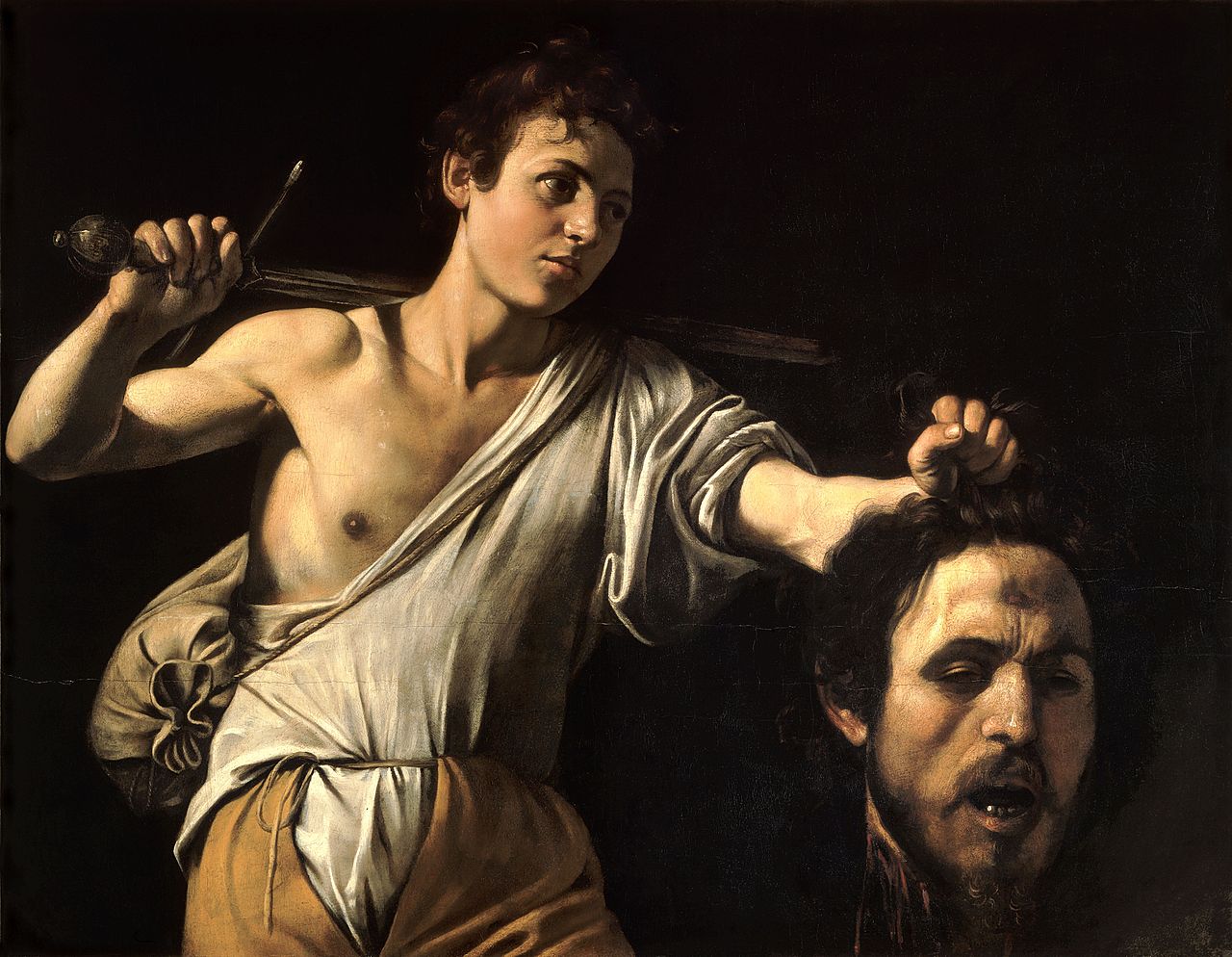
Chiaroscuro found its origins in the Renaissance period and used strong contrasts between dark and light in its compositions. The use of light can draw attention to certain details or its lack thereof can conceal them entirely, requiring a closer examination of what is being represented. The connotations between light and life, and death, darkness and the unknown have long been associated with one another, and this presence has been explored and enhanced through the use of chiaroscuro by many artists,  notably Caravaggio.

St. Jerome

Renowned for his unorthodox realism and exaggerated chiaroscuro (which became known as Tenebrism),  Caravaggio lived a volatile life and was often arrested for brawling. After one of these brawls resulted in him killing someone, a death warrant was placed on his head and he fled Rome.
His later works exhibit his anxieties surrounding the possibility of his impending death, incorporating  self-portraits into biblical tableus that feature depictions of decapitation shrouded in shadow.

Judith Beheading Holofernes
Salome with the Head of John the Baptist

David with the Head of Goliath


Chiaroscuro found continued use with the advent of photography and later cinema. Many have observed the inextricable relationship between photography and death. Both being representative of an eternal stasis, photography captures an image of a frozen moment in time, gone forever, just as in death the subjects time is now past and they are forever condemned to stillness.

In classic cinema the use of shadow would accentuate all of the qualities inherent in noir storytelling; the deception and danger that is concealed from the vulnerable protagonist through a web of seduction and lies that threatens to consume him is perfectly represented by the connotations between shadows and that which is unknown.


Cinematographers such as Robert Krasker and John Alton capitalised on the use of Chiaroscuro to enhance the mystery surrounding characters and create a brooding atmosphere typical of post-war era films that borrows heavily from German Expressionism.

The most prominent film of this movement is The Cabinet of Dr. Caligari (1920) which succeeds in projecting the subjective interior of a character into the exterior. The characters are surrounded by jagged shadows throughout which later come to greater prominence with their knife-like resemblance which reflects Cesare's intentions of killing.


Robert Krasker's cinematography in Carol Reeds noir thriller The Third Man (1949) casts heavy shadows from buildings to counter the dramatic lighting and envelope the characters into the unknown, favouring low angles to aid concealment. 


 The atmosphere created by the combination of harsh lighting and distorted camera angles can perhaps be best evidenced in the climatic chase through the sewers of Vienna as Orson Welles' character Harry Lime is pursued by the police. This youtube clip has inexplicably replaced the iconic score with 'Ich Will' by German industrial-metal band Rammstein, which though perplexing and perhaps even seen as defilement for some, the inclusion of Rammstein can only ever improve something in my opinion. (Perhaps the user was making a tenuous connection between Austrian sewers and German Metallers? I'm at a bit of a loss...) 


Ridley Scott's Neo-noir masterpiece Bladerunner (1982) casts its characters in shadow from artificial lights usually positioned behind them to reflect their doubts over the nature of their reality, and whether or not they are artificial 'replicants'. 


(I didn't mean to bombard this many images but there is just to much awesomeness concerning this film and omission proved too difficult)

When Rachel is introduced she is illuminated by the sun, however her face becomes cloaked in shadow when she is being tested as she begins to doubt whether or not she is really alive. Deckard is often cast in a similar light (or lack of) as his status as a possible replicant remains ambiguous throughout the film and is subject to interpretation. (There are several different cuts of the film, some which confirm his being a replicant and others which affirm his humanity)